autoinsurance
Showing posts with label Mercedes. Show all posts

Monday, March 21, 2011

2011 Carlsson Sport Cars C25 Royale Super GT Tuning Mercedes SL 65 AMG

2011 Carlsson Sport Cars C25 Royale Super GT Tuning Mercedes SL 65 AMG
Carlsson, one of German tuning firms, has brought to the show a maroon Mercedes named C25 Royale which took the Mercedes SL65 AMG as its platform, different with the others at above. Currently working on cars at the SL65 AMG, Car nuances of this sport cars have a lighter burden than ever before to 180 pounds.
2011 Carlsson Sport Cars C25 Royale Super GT Tuning Mercedes SL 65 AMG
As part of its new 2011 generation range, automobile manufacturer Carlsson presents its C25 Royale Super GT with carbon roof and exterior, optimised driving dynamics and perfected electronics. This gives an important role to the center of gravity is lower, in addition to reducing the weight of the car, the house is to optimize performance tuning so that the handling is better. Another major step is saving included installation of full-ceramic brake system, which is 50 percent lighter than the previous.
Carlsson C25 officially debuted last year at the 2010 Geneva Motor Show and this year in 2011 Geneva with more goodies and even cooler name. 2011 Carlsson Sport Cars C25 Royale Super GT Tuning is a project based on tuning for Mercedes-Benz SL 65 AMG. 2011 Carlsson Sport Cars C25 Royale Super GT Tuning Mercedes SL 65 AMG contains a number of elements from carbon fiber and the optimum driving dynamics and sophisticated electronics. Carlsson will only build 25 units of 2011 Mercedes SL-Class Super GT C25 Royale by Carlsson, a unit for each state vehicle was sold in.
2011 Carlsson Sport Cars C25 Royale Super GT Tuning Mercedes SL 65 AMG
Carlsson has realised more than 70 innovations in the new C25 Royale. The car's handling in particular is better than ever before. Plus, compared to the basis model Mercedes-Benz SL 65 AMG, the C25 Royale is 180 kilogram lighter which is due largely to the complete real carbon exterior. This not only reduces the overall weight of the Super GT, it also effectively lowers the car's centre of gravity and allows more dynamic cornering ability and more agile handling as Carlsson has revised the vehicle's entire weight distribution and installed a differential lock. The full ceramic brake system reduces the weight by 50 percent and reduces the unsprung mass for a more dynamic handling. The generously designed ceramic brake discs and the solid aluminium callipers allows later braking coming into bends while the revised electronics guarantee improved response, giving greater dynamism when coming off bends.
The 2011 Carlsson Sport Cars C25 Royale Super GT Tuning Mercedes SL 65 AMG's outstanding performance data is impressive too. The strikingly beautiful sports cars coupé with the V12 biturbo engine achieves 753 hp (554 kW) and maximum torque of 1320 Newton metres (which is limited electronically to 1150 Newton metres). This allows the Super GT to race from 0 to 100 kph in just 3.7 seconds and to achieve a maximum speed of 352 kph.
The 2011 Carlsson Sport Cars C25 Royale Super GT Tuning Mercedes SL 65 AMG is not just an exclusive vehicle with outstanding performance data. The engineers at Gut Wiesenhof, Carlsson's headquarters in Germany, are the ones in the world to bring together the performance data of a super car with everyday practicality. "There are more than enough super cars around that can only be driven safely on a racing track", says engineer Markus Schuster, Managing Director at Carlsson. "We deliberately wanted to develop a car that is exclusive on the one hand but can still be used for the daily commute to the office. A Super GT which can go from 0 to 100 kph in just 3.7 seconds while at the same time offering the utmost in ride comfort."
2011 Carlsson Sport Cars C25 Royale Super GT Tuning Mercedes SL 65 AMG
In particular, the intelligent C-Tronic® SUSPENSION developed by Carlsson guarantees excellent ride comfort. This system measures a whole range of parameters, like the spring rate, on a continuous basis, which allows it to detect the road conditions and the driving style. Where road conditions are poor, the C-Tronic® raises the residual spring travel, thereby providing optimal ride comfort. As soon as the surface conditions have improved, the system will lower the entire suspension completely automatically and achieve perfect cornering dynamics.
2011 Carlsson Sport Cars C25 Royale Super GT Tuning Mercedes SL 65 AMG
In addition, Carlsson (which has been recognised as an independent manufacturer for some years now by the German Federal Motor Transport Authority Kraftfahrtbundesamt) can offer one excellent unique selling point: Not more than 25 specimens of the 2011 Carlsson Sport Cars C25 Royale Super GT Tuning Mercedes SL 65 AMG are being made. And, to enhance the exclusivity of this ultra-limited edition still further, Carlsson is only delivering one vehicle per country. Six vehicles are already sold and will be delivered to the customers in 2011. It takes six month from order to delivery.

Thursday, January 27, 2011

Mercedes Benz Sports Cars Concept Blackbird Tron Legacy

Mercedes Benz Sports Cars Concept Blackbird Tron Legacy
New concept cars from Mercedes Benz, Mercedes Benz Sports Cars Concept Blackbird Tron Legacy, created for the 2010 Australian International Motor show. At least, that's the abstraction abaft Peter Vardai's new Mercedes aggressive Blackbird abstraction car.
Mercedes Benz Sports Cars Concept Blackbird Tron Legacy
The Mercedes Benz takes elements from airplanes, absorption on acceleration and movement with capacity aggressive by the TRON legacy. Maybe in the abutting cine the TRON aggregation can advancement the lightcycle and barter it in for a badass Benz.
Mercedes Benz Sports Cars Concept Blackbird Tron Legacy
New concept of Tron Lagacy in the shape of “Blackbird” a stylish Car. Paying tribute to the Mercedes-Benz, the Hungarian designer Peter Vardai invented a concept car called the “Blackbird”, which is built on the idea of speed and freedom of feelings towards the strengthening of the brand.
Drawing its name from the fastest manned aircraft, Lockheed SR-71 Blackbird, the new car is equipped with a bow and lights to emphasize the sporty Mercedes.
Mercedes Benz Sports Cars Concept Blackbird Tron Legacy
Made in 2010, the Australian International Motor Show, Mercedes Blackbird inspired by the latest Hollywood blockbuster, Tron Legacy, just like Audi’s E-Tron concept. Moreover, the Mercedes Tron vehicle makes use of novel colors to suit the movie.
Mercedes Benz Sports Cars Concept Blackbird Tron Legacy

Thursday, January 20, 2011

2011 Mercedes Benz CL550 4Matic Coupe Luxury Sport Sedan

2011 Mercedes Benz CL550 4Matic Coupe Luxury Sport Sedan
The 2011 Mercedes-Benz CL550 comes with the latest technology while providing a comfortable ride, but the car needs a better approach to driving at low speeds. The 2011 Mercedes Benz CL550 4Matic Coupe Luxury Sport Sedan CL-Class has been unveiled and Stuttgart’s large coupe gets some nice exterior and interior upgrades. However the most significant changes come under the hood with the new 2011 CL550 getting a new 4.6L V8 twin-turbo making 429-hp and a maximum torque of 516 lb-ft. The out going model made 382-hp and a peak torque of 391 lb-ft. Even with that increase in power, fuel-economy has been improved by 10-15 percent. The 2011 Mercedes-Benz CL550 4MATIC goes from 0-60 mph in just 4.9 seconds (previous model did it in 5.4 seconds) with a top speed of 155 mph (electronically governed).
2011 Mercedes Benz CL550 4Matic Coupe Luxury Sport Sedan
These new engines make their U.S. debut in the restyled 2011 Mercedes Benz CL550 4Matic Coupe Luxury Sport Sedan CL-Class set to arrive at Mercedes-Benz dealerships in November. The flagship coupe of the Mercedes-Benz model range, the CL-Class features a new hood, fenders, grille, bi-xenon headlights with LED turn signals and daytime running lights. The rear of the vehicle incorporates new LED taillights, bumper-integrated exhaust pipes and reverse lights now located in the trunk lid. Inside, the interior includes new steering wheel design and interior colors.
2011 Mercedes Benz CL550 4Matic Coupe Luxury Sport Sedan
New V8 bi-turbo engine with innovative technology. The new-generation CL-Class also assumes a pioneering role with its drivetrain. Under the hood of the CL550 4MATIC a new V8 biturbo engine with BlueDIRECT technology delivers impressive power. With its 4663 cc displacement, the eight-cylinder engine produces 429 hp so that despite 0.8 liters less displacement, it is still around 12 percent more powerful than its predecessor, which had an output of 382 hp. At the same time, torque was raised from 391 lb-ft to 516 lb-ft ““ an increase of 32 percent.
2011 Mercedes Benz CL550 4Matic Coupe Luxury Sport Sedan
The new engine achieves a 10-15% improvement in fuel economy and 23% improvement in CO2 emissions. The CL550 4MATIC requires a mere 4.9 seconds to accelerate from a standstill to 60 mph (previous model: 5.4 seconds). Summing up: the CL550 4MATIC is significantly more agile, torquey and thriftier than its predecessor.
The air suspension and standard all-wheel drive with 2011 Mercedes Benz CL550 4Matic Coupe Luxury Sport Sedan complex while the seats massage care occupants. The 3D navigation system provides the detail, and Harman Kardon stereo sounds excellent. night vision and adaptive cruise control add security and comfort. Mercedes-Benz fits the cabin of the CL550 with superb standard technology and then makes more items available that push the tech envelope even further. Think blind-spot detection, adaptive cruise control, and even a night-vision system. Imagine a main video screen that lets the driver look at navigation while the front passenger watches a movie.

Tuesday, April 27, 2010

Mercedes-Benz S400 BlueHYBRID

Mercedes-Benz S400 BlueHYBRID

The combination of a modified V6 petrol engine and a compact hybrid module makes the Mercedes-Benz S400 BlueHYBRID the world's most economical luxury saloon with a spark-ignition engine. The NEDC combined fuel consumption is a mere 7.9 litres per 100 kilometres. This makes for the world's lowest CO2 emissions in this vehicle and performance class - just 190 grams per kilometre. These exemplary figures go hand in hand with assured performance. The 3.5-litre petrol engine develops an output of 205 kW/279 hp, the electric motor generates 15 kW/20 hp and a starting torque of 160 Nm. The result is a combined output of 220 kW/299 hp and a combined maximum torque of 385 newton metres. Moreover, the new Mercedes-Benz S400 BlueHYBRID is the first series-production model to be equipped with a particularly efficient lithium-ion battery specially developed for automotive use. This is another major contribution by Mercedes-Benz to the electrification of the car.
The new Mercedes-Benz S400 BlueHYBRID is based on the S350, and features an extensively modified drive train. This encompasses a further development of the 3.5-litre V6 petrol engine, an additional magneto-electric motor, the 7G-TRONIC seven-speed automatic transmission specially configured for the hybrid module, the necessary operating and control electronics, the transformer and a high-voltage lithium-ion battery.
The compact hybrid module is a disc-shaped electric motor that also acts as a starter and generator. The system offers a double benefit, as it both helps to save fuel and increases driving enjoyment. This is partly due to the booster effect of the electric motor, as it powerfully backs up the petrol engine with a maximum additional torque of 160 newton metres during the high-consumption acceleration phase. The driver benefits from the combined action of these two units in the form of even more impressive torque characteristics and smooth, effortlessly superior acceleration.
The hybrid module also has a comfortable start/stop function, which switches the engine off when the vehicle is at a standstill - for example at traffic lights. When it's time to move off again, the electric motor almost imperceptibly restarts the main power unit. This likewise makes a contribution to fuel economy and environmental protection: because the engine restarts first time, and practically instantly, emissions are also minimised during the starting phase.
When the vehicle is braked the electric motor acts as a generator, and is able to recover braking energy by a process known as recuperation. Working in finely tuned partnership, the electric motor supplements the braking effect of the petrol engine and the wheel brakes to deliver a smoothly progressive braking action. The recuperated energy is stored in a compact yet highly efficient lithium-ion battery in the engine compartment, and made available when required. This complex system is managed by a high-performance control unit, which is likewise located in the engine compartment.
Mercedes-Benz S400 BlueHYBRID

The centrepiece of the modular, very compact and highly efficient hybrid drive system is the new high-voltage lithium-ion battery, which was specially developed for automotive use and is the first such unit worldwide to be introduced in a series-production vehicle. In this way Mercedes-Benz is making a trailblazing contribution to the electrification of the car, with the Mercedes-Benz S-Class once again playing the role of the technological trendsetter.
Major advantages over conventional nickel/metal hydride batteries include a higher energy density and better electrical efficiency, together with more compact dimensions and a lower weight. Thanks to space-saving installation in the engine compartment, where it replaces the conventional starter battery, the generous interior space and boot capacity of the S400 remain unchanged. The lithium-ion battery not only stores energy for the electric motor, but is also connected to the 12-Volt onboard network via the transformer to supply power to other standard consumers such as the headlamps and comfort features. The completely newly designed battery system consists of the cell block with its lithium-ion cells and the cell monitoring system, the battery management function, the high-strength housing, the cooling gel, the cooling plate, the coolant feed and the high-voltage connector.
The 3.5-litre V6 petrol engine with variable valve control has been throughly re-engineered and improved. In the process the development engineers made use of the advantages offered by the Atkinson principle,where the expansion phase is longer than the compression phase. The intake valve is kept open slightly longer between the intake and compression phases, which improves the engine's thermal efficiency while reducing the specific fuel consumption and untreated emissions. A new cylinder head, different pistons and a modified camshaft with different camshaft control increase the output by 5 kW/7 hp to 205 kW/279 hp - while reducing fuel consumption at the same time.
The compact, disc-shaped electric motor, which is space-savingly installed in the torque converter housing between the engine and the 7G-TRONIC seven-speed automatic transmission, improves efficiency even further. This is a 3-phase AC external rotor magneto motor, which develops a peak output of 15 kW/20 hp and a starting torque of 160 newton metres with an operating voltage of 120 Volts.
The Mercedes-Benz S400 BlueHYBRID accelerates from zero to 100 km/h in 7.2 seconds, and reaches an electronically governed top speed of 250 km/h. The Mercedes-Benz S400 BlueHYBRID betters the already very favourable NEDC fuel consumption of the conventionally powered S350 by up to 2.2 litres per 100 kilometres. CO2 emissions are reduced by 21 percent.
In addition the hybrid module features an extremely comfortable and efficient start/stop function, which already switches the engine off when the vehicle is rolling to a stop at less than 15 km/h, for example before stopping at traffic lights. When it's time to move off again, the electric motor immediately and imperceptibly restarts the main engine as soon as the driver releases the brake pedal or operates the accelerator. This likewise contributes to fuel economy and environmental conservation: as the engine restarts practically instantly, emissions are also minimised during the starting phase. The vibrations and jolts that are unavoidable when starting with a conventional starter are also reduced to a minimum.
The new S400 BlueHYBRID exemplifies the strategy of Mercedes-Benz, whose declared aim is to offer the brand's customers economical and environmentally compatible premium cars - without compromising in terms of typical brand attributes such as safety, comfort and a superior driving experience.
Major areas of development focus include modular drive technologies, which are used on a stand-alone basis or in combination depending on the vehicle class, operating profile and customer requirements - Mercedes-Benz has already described how this applies to the product portfolio in its "Road to the Future". In this context Mercedes-Benz also provides an outlook on the future of the internal combustion engine, with the innovative DIESOTTO engine in the Mercedes-Benz F700 research car.

Tuesday, April 6, 2010

Mercedes Supercar C.S.V Concept With BCI System

The Mercedes Benz Cyborg Sensation Vehicle, or C.S.V., is a concept car imagined by Chinese designer Derek Chik Kin Ng. The C.S.V. is an off-road capable, two-seater supercar, Inspired by the Mercedes F400 concept, designed back in 2001, is targeted to young adventurous professionals in 2040.
Mercedes Supercar C.S.V Concept
Its pretty obvious, (thanks Captain Oblivious) what the core concept of this vehicle is just by name. Technology and organics are bound to merge sooner or later. Imagine driving just by thinking. When you sit in the drivers seat, your though patterns are sent to the vehicle, thus becoming an extension of your body. Theres no need for analog controls.
Mercedes Supercar C.S.V Concept
Mercedes F400 concept has served as the inspiration when creating this concept car of the future. It foreshadows a fully integrated driver interface, providing “driving…by thinking”.
Mercedes Supercar C.S.V Concept
The interesting part about this Mercedes Benz concept is that it has no steering wheel, no pedals, but this vehicle can be controlled with the power of mind instead. It uses a system named Brain Computer Interface (BCI), which creates a connection between the car and its driver, through a specially-designed helmet.
Mercedes Supercar C.S.V Concept
This way, the driver’s brain impulses are gathered by the helmet and transferred to the car, which responds appropriately. Although this principle may sound plausible in the future, its implementation on cars, could prove to be quite a difficult task.
Mercedes Supercar C.S.V Concept
The implications for such technologies means someday well know how to interpret, map out, and respond to human neural patterns. If you can put that thought aside for a second, lets focus on the design. 
Mercedes Supercar C.S.V Concept
Theres a lot of F400 in there but the designer wanted to give the vehicle an organic flavor, hence the muscle fibers flanking each side, neatly tucking into a hidden skeletal system. The result is a design that takes Mercedes Benz DNA and evolves it into an organic object mimicking its pilot.
Mercedes Supercar C.S.V Concept

Thursday, January 7, 2010

Mercedes-Benz BlitzenBenz Concept Car Production year theoretical 2025

Mercedes-Benz BlitzenBenz concept car

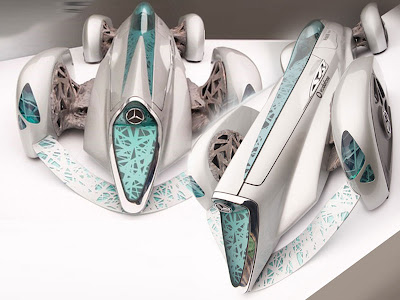
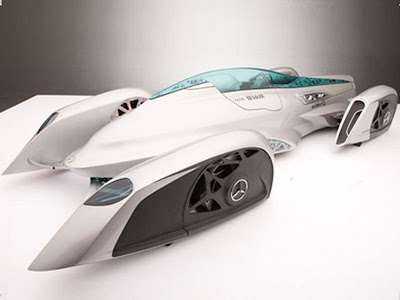
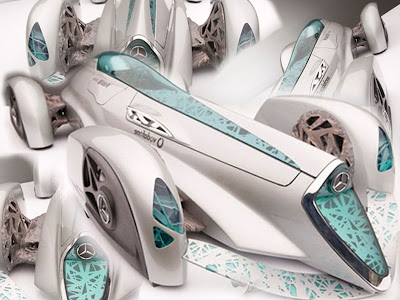
Mercedes-Benz BlitzenBenz concept car Production year theoretical 2025. Brilliant and outstanding is what every car lover will exclaim when will see this BlitzenBenz concept car. The Mercedes-Benz BlitzenBenz concept was created by George Yoo, a designer at Mercedes-Benz Research and Development in Carlsbad, California. The BlitzenBenz was developed during his final year at the Art Center College of Design in Pasadena.
Mercedes-Benz BlitzenBenz concept car

Created by George Yoo as a futuristic racing vehicle, BlitzenBenz concept is derived from two different sources. And let me tell you the roots of its design are in the past. The main inspiration behind the idea is from original Blitzen-Benz from 1909 that had a long tubular shape and rear cab positioning. On the other, Alex Erlandson work of creating sculptures from trees that were grown into certain shapes/patterns influenced Yoo considerably to contemplate what if automotive parts were to be grown and tamed to hold certain shapes.
Mercedes-Benz BlitzenBenz concept car

Obviously the technology is not quite there yet to create such a vehicle, but the current research into nanotechnology is paving the way for intelligent and adaptable components which can be grown instead of manufactured. It's an incredibly interesting prospect which would completely alter the way cars are built, maintained, upgraded and recycled.
Mercedes-Benz BlitzenBenz concept car

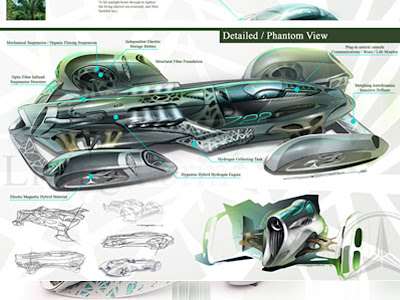
The exterior design is a base for the organic structure and the individual wheel pods are there to sense as to when the inside electric motors need to be cooled down. When the cooling will be required, these structures will open up in the same way as the plants do to receive the vital sunlight.
Mercedes-Benz BlitzenBenz concept car

To run this Mercedes-Benz BlitzenBenz, there is an advanced next-generation Hygenius hybrid hydrogen engine and four in-wheel electric motors. The inspiration for the blue lightening system came from bioluminescent capabilities of deep sea creatures. Also, a hydrogen storage tank is just below the cockpit and the fuel level is shown in a small window.
Mercedes-Benz BlitzenBenz concept car

Though, woefully, there is no technology to make this vehicle as such, but the progressing research into nanotechnology will surely open the way for components that can be grown than manufactured, changing the way cars will be built or maintained in future.

Wednesday, December 9, 2009

2011 Mercedes-Benz SLS AMG The Super Sports Car Debut at The Frankfurt Motor Show

2011 Mercedes-Benz SLS AMG

Mercedes-Benz’s highly-anticipated SLS AMG, which takes the iconic 300SL Gullwing to the next generation, is set to debut next week at the Frankfurt Motor Show.
“With the new SLS AMG, Mercedes-Benz is presenting a fascinating super sports car that will quicken the pulse of any car fan. The SLS AMG bolsters both the Mercedes-Benz and AMG brands equally, and will surely become one of the most alluring sports cars of our time,” says Dr. Dieter Zetsche, Chairman of the Board of Management of Daimler AG and Head of Mercedes-Benz Cars.
2011 Mercedes-Benz SLS AMG

The performance highlights start under the long, shapely hood: 6.3-liters of AMG-massaged V8 will pump out 571 horsepower at 6,800 rpm and 480 lb-ft. of torque at 4,750 rpm transmitted to the transaxle-mounted seven-speed SpeedShift dual-clutch transmission. With this powertrain, the SLS AMG will accelerate to 62 mph in 3.8 seconds before topping out at about 197 mph.
Stuttgart/Affalterbach — Automotive fascination and high tech of the highest order: These are the traits embodied by the new Mercedes-Benz SLS AMG, which is making its world premiere at the International Motor Show (IAA) in Frankfurt on 15 September 2009. The super sports car boasts a purist design, the systematic incorporation of lightweight engineering and superior handling dynamics. At the same time, the SLS delivers the high everyday utility and exemplary safety that typifies Mercedes-Benz, making the new gullwing the ideal synthesis of the strengths of Mercedes-Benz and AMG.
2011 Mercedes-Benz SLS AMG

The new super sports car from Mercedes-Benz and AMG dazzles with its unparalleled technology package which includes: an aluminium space frame body with gullwing doors; an AMG 6.3-litre, front-mid V8 engine with a top power of 571 hp, 650 Nm of torque, and dry sump lubrication; seven-speed dual-clutch in a transaxle configuration; a sports chassis with aluminium double-wishbone suspension; and a kerb weight of 1,620 kilograms. It's a combination that guarantees supreme handling dynamics. The car's ideal weight distribution between the front and rear axles (47 to 53 per cent respectively) and its low centre of gravity emphasize the concept's pronounced sports car nature.
2011 Mercedes-Benz SLS AMG

The gullwing accelerates from 0 to 62 mph in 3.8 seconds and has a top speed of 197 mph (electronically limited). The fuel consumption of 21.4 mpg (combined) is best-in-class (all figures are provisional).“With the new SLS AMG, Mercedes-Benz is presenting a fascinating super sports car that will quicken the pulse of any car fan. The SLS AMG bolsters both the Mercedes-Benz and AMG brands equally, and will surely become one of the most alluring sports cars of our time,” says Dr. Dieter Zetsche, Chairman of the Board of Management of Daimler AG and Head of Mercedes-Benz Cars.
2011 Mercedes-Benz SLS AMG

Mercedes-Benz says the SLS AMG will retail from €177,310 (including VAT) in Europe when it goes on sale in spring of 2010, although the automaker has not released pricing or an on-sale date for North America.


Related Posts Plugin for WordPress, Blogger...
 

blogger templates | Blogger